

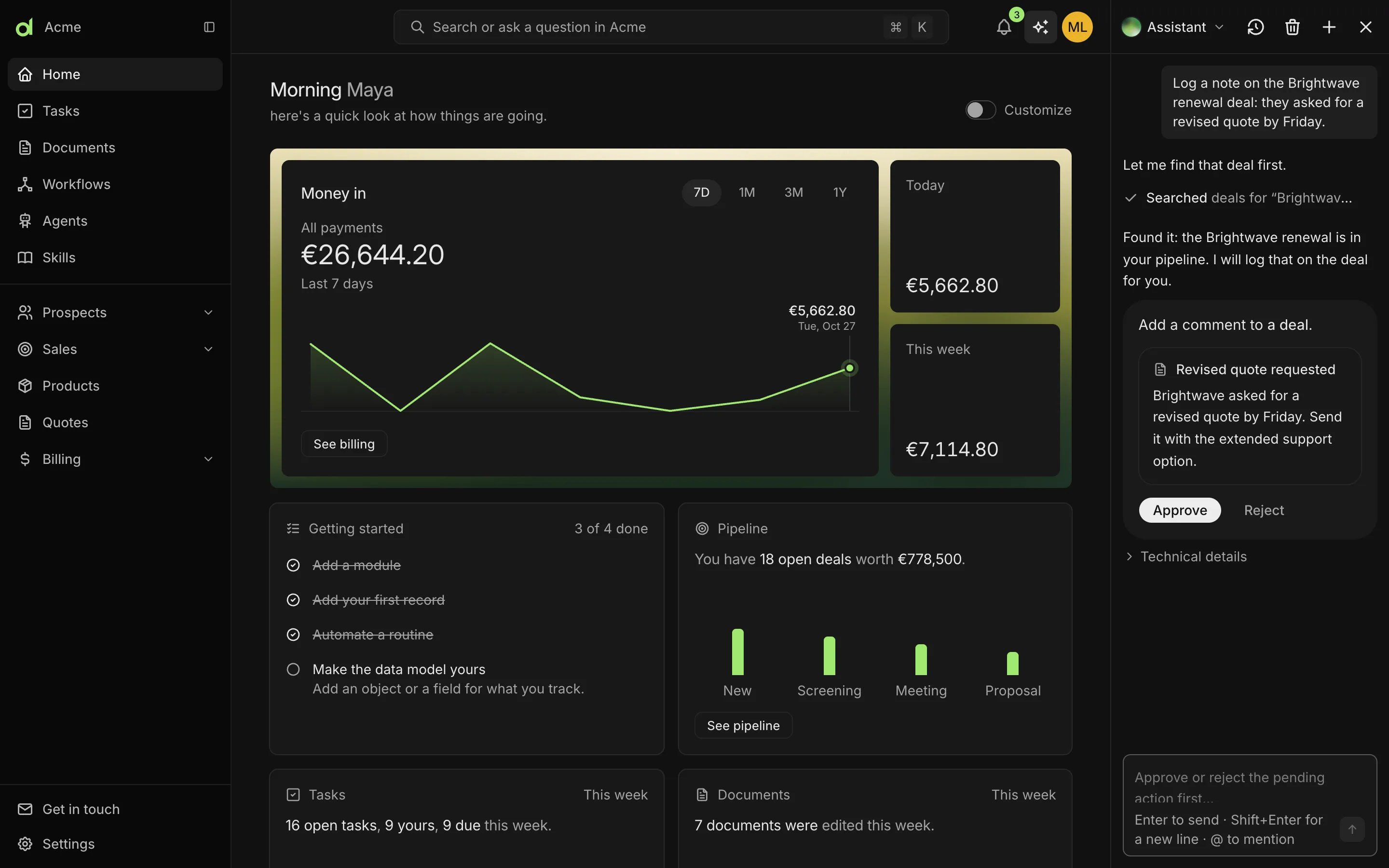
The Home page of the studio, with the assistant asking before it changes a deal.
Parts of Devias
See Architecture.
Properties
- Modular. Each area of the business is a module. Modules are installed from a reviewed plan, and a workspace can build its own. See Modules.
- Data defines the product. Objects and fields are stored as data, so a field added in Settings and a field a module ships behave the same, and a change needs no rebuild. See Data model.
- Agents with limits. An agent acts with the role of the person who asked. Each of its tools runs freely or asks first, and every change is logged. See Agents.
- Open and extensible. The platform is under the AGPL-3.0. The SDK, the UI kit and the CLI are MIT. There is a React studio, TypeScript modules, a typed SDK and an HTTP API described in OpenAPI.
- Self-hosted. It runs on your own server with Postgres, or with an embedded database to try it. A hosted cloud version is planned and has no price yet.
When Devias fits
- A business process does not fit a standard CRM or ERP, and the data, rules and hosting should stay under the company’s control.
- A team or agency builds operations software for clients and wants a base to build on instead of an empty repository.
When Devias does not fit yet
- The need is a fully mature, hands-off product today. Devias is young and changes quickly, and some areas are rough.
- Nobody can write TypeScript, and the need goes beyond what Settings and the assistant can configure.
- Other agents, such as Claude or ChatGPT, must use Devias directly. Connecting them through MCP is planned. Today the agent inside Devias uses the same actions as the app.